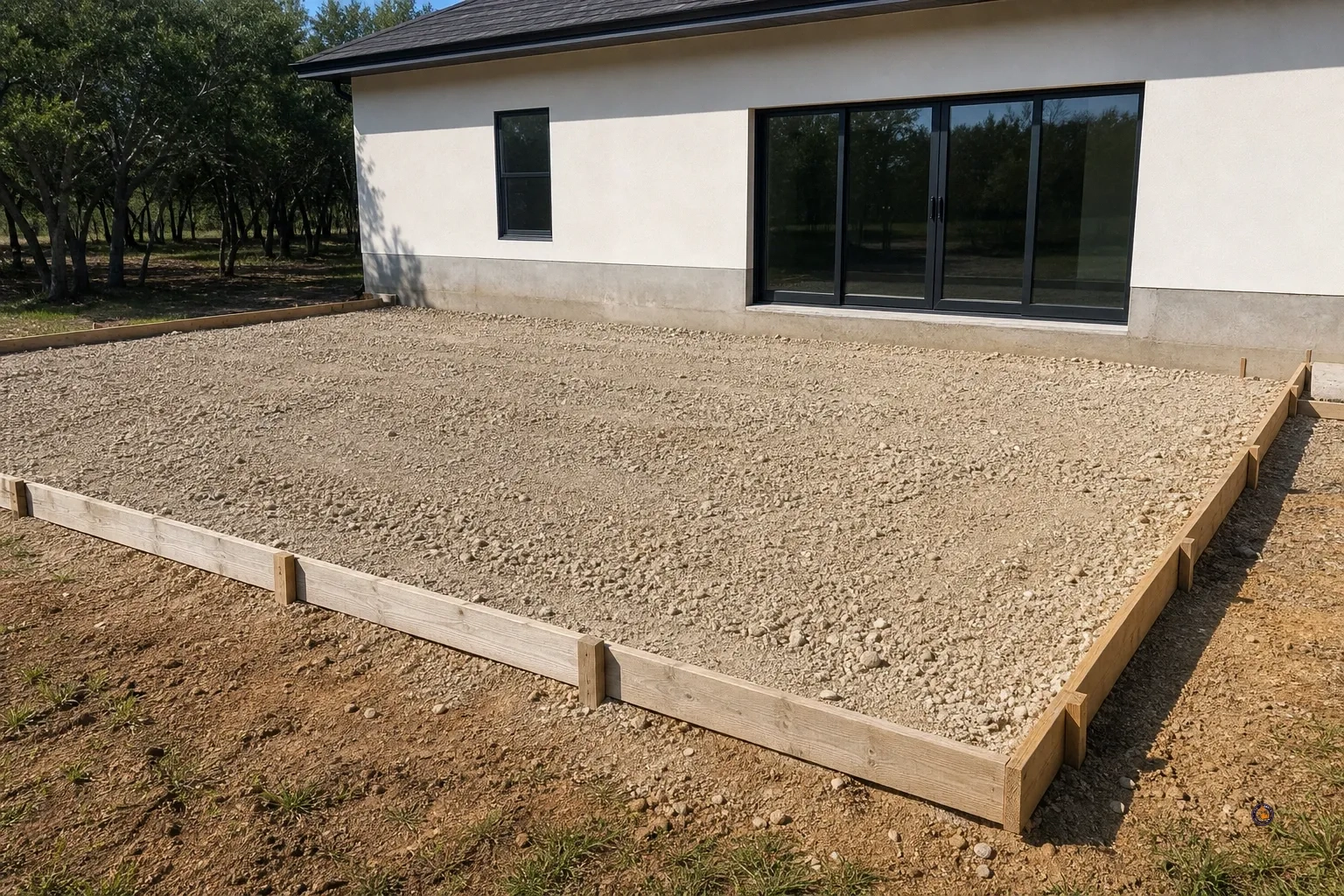
Before you select a concrete contractor, make sure the bid spells out the prep work. That is the fastest way to avoid surprise costs and to get a slab, patio, pool deck, or driveway that actually lasts.
Start with scope, not price
Two numbers that look similar can hide very different jobs. Ask every bidder to name what happens before the ready-mix truck shows up. At minimum, get clarity on: Demolition and haul-off of existing materials, if any. Subgrade evaluation and correction. What are you building on, and how will soft spots be handled?
What goes under the slab and how is it compacted? Drainage planning. Where will surface water go after the pour, and how will slope be established?
Control joint approach. How will joints be created and laid out to help manage cracking? Access and protection. How will the crew reach the work area and protect adjoining landscaping or finishes?
Cleanup. What gets hauled away, what stays, and what “site-ready” looks like when the crew pulls out.
Why the “cheapest” bid often ends up most expensive
When prep work is not priced up front, it tends to reappear as change orders or shortcuts: No base allowance. The crew discovers saturated or pumping subgrade, then charges extra for base rock and compaction you assumed was included. Drainage as an afterthought.
Missing joint plan. Joints get sawcut wherever is quickest, rather than where the slab wants to move. Random cracking shows up and is suddenly “not covered.” Haul-off excluded. Demo debris or spoils pile up and a separate truck is added to the bill.
Access ignored. Fences come down or landscaping is damaged, then repair is “not in scope.”.
What “prep” looks like behind the scenes
Useful questions to bring to any bid meeting: Subgrade. How will you assess bearing and moisture? Base. What material and gradation do you propose beneath the slab, and how many compaction passes are assumed?
Water movement. How much fall will be built into the slab or surrounding grade, and where will downspouts and surface water go once the concrete is in place? Joints. Where will control joints go, and how will they be made? Hand-tooled or sawcut, and on what timeline after the pour?
Edges and interfaces. How will the slab meet existing concrete, foundations, thresholds, coping, or pavers? Access and staging. What path will trucks and equipment use, and what protection is planned for turf, trees, and hardscape?
Cleanup and washout. Where will washout and slurry be contained so it does not end up in the lawn or storm drains?
These are not “gotcha” questions. They simply document decisions that should be made before concrete is ordered.
The ten-minute bid comparison that protects your budget
Print both bids. Use a pen and answer these on each: Demo and haul-off named, with who pays for unforeseen debris? Subgrade evaluation described and a plan for soft spots identified?
Base material and compaction approach stated? Drainage direction and finish elevation clarified relative to the house and yard?
Control joint method and layout approach named? Access route, staging, and lawn or hardscape protection explained?
Cleanup standard and haul-off final condition stated? Start window, pour window, and how weather delays are handled?
Change-order trigger and pricing method defined? Who calls for locates and any required permits?
If at least three of these boxes are blank on a bid, the “cheap” number is not a number you can rely on.
What a complete estimate usually clarifies
Look for: Site specifics. Tasks and sequence. Prep, forming, reinforcement if specified by plan, pour, finishing, sawcuts or tooled joints, curing approach, cleanup.
Material callouts. Mix design if provided by spec, finish type, color or release if decorative, and sealer if part of the scope. Responsibilities. Who handles demo, utility locates, permit pulls if applicable, and inspections if required.
Schedule windows. When prep begins and a target pour range, with weather allowances. Protections. How adjacent surfaces and landscaping will be protected and restored.
This level of clarity is the difference between a price and a plan.
Where homeowners and property managers lose money
Square-foot pricing without a site walk. A per-square-foot number before anyone looks at your yard ignores the variables that actually decide cost and performance. Assuming “standard” details. There is no universal standard that fits every driveway, patio, or sidewalk. Lot slope, access, existing structures, and the way you use the space drive details.
Treating cracks as purely cosmetic or purely structural. Cracks have causes. Some reflect normal shrinkage and movement, others reflect base or drainage issues that will keep costing you until they are addressed. If you are weighing fixes, our Austin 2026 cost guide for repair versus replacement frames the decision.
You do not have to be an engineer to ask the right questions. You just have to insist that your bid describes the job you actually need done.
How this applies across residential and commercial work
Whether the project is a residential patio or a commercial sidewalk, the logic does not change: Residential patios and driveways. Forming around steps, garages, gates, and landscaping is labor. If it is not named, it is coming later as an add-on or as damage you did not plan for. Pool decks. Safety textures and jointing must be coordinated. If a resurfacing is proposed, the prep scope should specify how existing cracks and transitions will be treated.
Commercial sidewalks and approaches. Pedestrian access and phasing are part of the scope.
Bringing the conversation back to your site
Every good project starts with a site read: Where does water collect now, and how will that change? What is the simplest, least destructive access path?
What existing concrete, thresholds, posts, or utilities does the new work have to meet? If you are expanding a slab, what is the plan for the cold joint where new meets old?
If you want to go deeper
To understand how contractors translate design into field steps, review our walkthrough of the concrete contracting process. If you are debating base decisions, start with Is gravel needed under concrete. It puts practical context around base choices.
Curious why cracks appear and how to plan joints to manage them? Read Why concrete cracks in Austin TX.
When you are ready to compare bids for a new driveway, patio, sidewalk, pool deck, or retaining wall, use the checklist above and insist the prep work is in writing. That is how “affordable” stays affordable after the crew leaves.