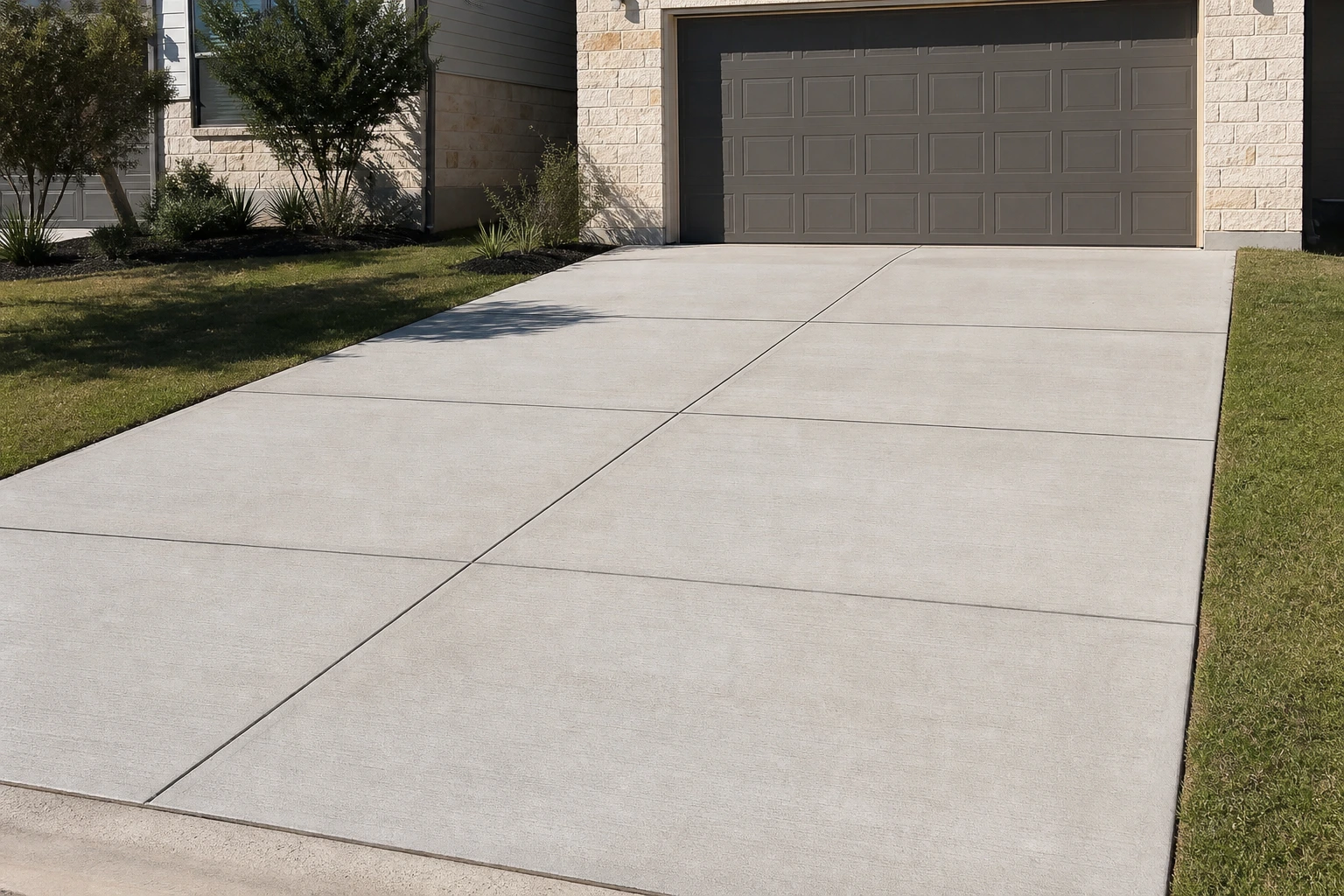
You’re staring at cracks, settled sections, or a chalky, flaking surface and debating another patch versus a full concrete driveway upgrade. Austin’s heat, intense sun, and big rain swings can push a worn slab past the point where repairs last, and it’s hard to tell from curbside.
This guide lays out the telltale signs a driveway is past repair, how our climate speeds wear, finish options that hold up and look sharp, what drives the timeline, and how to read bids without surprises. By the end, you’ll know if it’s time to repair or upgrade, and how to move forward with confidence.
Visible signs your driveway is past repair
If you’re seeing structural failures rather than surface blemishes, patch repairs usually won’t last and full replacement is often the better fix. In some cases, a targeted Concrete Resurfacing approach can refresh sound slabs while improving appearance and traction. In Central Texas, the big red flags are easy to spot once you know what to look for.
Wide or multiple cracks. Replacement is often the better option when cracks run across much of the slab or have opened enough to collect dirt and gravel even after sealing. Heaving/settling. Sections that have lifted or sunk leave trip lips and ponding; this points to base or soil issues under the slab, not just the surface. Alligator cracking. A web of small, interlaced cracks usually means the slab is failing below the surface, not just at the top. Chronic drainage rutting. Wheel paths that hold water or channel runoff suggest the surface or base has deformed and will likely keep getting worse. Severe spalling. When the top layer flakes off in patches and exposes coarse aggregate, the surface is breaking down.
If a few isolated areas are the only problem, targeted Concrete Repair Services can still make sense.
Austin-specific stressors that speed up driveway wear
Central Texas drives live through big heat swings. Hot afternoons and cooler nights make concrete expand and contract, which widens existing cracks and pops weak patches. Intense sun bakes the surface, drying it too fast and aging sealers; unsealed slabs get surface dusting and color fade sooner.
Local soils add movement. Many Austin lots sit on expansive clay that swells when wet and shrinks when dry, lifting or dropping panels unevenly. Without a well-compacted base and good subgrade drainage, you see heaving at the apron and settled tire tracks.
Heavy storm runoff works like a pry bar. Concentrated flow erodes edges, washes fines from the base, and leaves rutting where water sits. Standing water also seeps into cracks and softens subgrade.
Designs here should plan for movement and water: proper thickness for loads, control joints (planned cuts to guide cracks) at smart spacing, a well-graded base, and driveway slopes that move water away from the slab.
Repair or replace: the simple rule to decide
Use this rule of thumb: repair when the damage is isolated and the slab is stable; replace when there’s movement, base failure, or widespread defects that outgrow spot fixes. If hairline cracks are tight, a few spalls (surface pits) are shallow, and the slab is level, patching and joint sealing usually hold up well. If sections rock under load, new cracks keep forming, or water ponds, the root problem is likely below the slab.
Choose repair if:
- Cracks are narrow and not offset (no height difference across the crack).
- Only a limited area is affected, as a rule of thumb rather than a hard cutoff.
- Drainage still sheds water off the slab, not toward the house or garage.
Choose replacement if:
Multiple areas have settled or heaved, or wet spots push up muddy water through joints or cracks. Extensive network cracking covers large areas, or spalling (surface flaking or pits) is deep and widespread. Drainage ruts or ponding persist after past repairs, indicating a failed base.
Upgrade options that boost curb appeal and durability
Here are practical driveway finishes that hold up in Central Texas sun and storm bursts while looking sharp:
Standard broom finish. A simple brushed texture that adds traction. Good for tight budgets and low maintenance. Works well on sloped drives where rain runs fast. Exposed aggregate. The surface is washed to reveal pebbles. It hides dust and tire marks and adds grip in downpours. Best when you like natural, Hill Country stone looks. Stamped concrete. A patterned surface that mimics stone, slate, or pavers. It usually needs a surface sealer (most makers suggest recoating every 2 - 3 years, often sooner on sunny south or west exposures). See pattern options for Stamped Concrete.
Integrally colored slabs. Color is mixed through the concrete, so light wear is less likely to show a pale scratch. Pair it with a light broom or sandblast for heat-friendly, low-glare surfaces.
If you want richer tone without pattern, acid or water-based Concrete Staining adds color variation; plan on periodic sealer per the product used.
What affects the total project timeline
Demo and haul-off. Usually 1 day for a typical two-car driveway. Extra time if there’s thick old concrete, rebar to cut, or tight truck access. Subgrade evaluation and base prep. 1 - 2 days to check and compact the soil, and add 4 - 6 inches of road base where needed (a common rule of thumb on expansive soils). Add time for drains or stabilization fabric if drainage is poor. Forms, layout, and reinforcement. Half to 1 day to set forms, check drainage slope, and place rebar or wire mesh (as specified). Pour and finish. One day for placing concrete, leveling, broom finish or stamping, and edging. Stamped or exposed aggregate adds setup and cleanup time.
Saw-cut control joints. Usually the same day or next day, once the slab can be walked without marks. More joints mean a bit more time. Curing before traffic. Most mixes need 7 days before light vehicles (a common guideline), longer for heavy loads or cool, damp weather. Weather holds. Summer heat, surprise storms, or saturated subgrade can each push the schedule by a day or more.
Cost drivers to understand before you get bids
Budget swings on a few big levers. Size and thickness set the concrete and labor load, more square footage and thicker sections (a common rule of thumb is 4 inches for cars, 5 - 6 inches where heavy loads sit) raise cost. Base improvements and drainage matter in Central Texas expansive clay; undercutting soft spots, adding road base, and adding drains or swales cost more but help reduce future movement. Access and demo affect hauling and setup, tight lots, tree roots, and breaking out thick or reinforced old slabs increase equipment time. Reinforcement, rebar or welded wire mesh, costs more than fiber-only mixes and can help limit crack width in clay soils.
Finishes change labor: a standard broom is least expensive; exposed aggregate, integrally colored slabs, and stamped patterns add steps, materials, and sealing. Permits and HOA approvals vary by city and subdivision; fees and required inspections add admin and schedule time (your city’s permitting office decides). Driveway design and finish options also affect price; learn more at Concrete Driveways.
Checklist: what a driveway bid should include
Ask for these specifics in every driveway bid so you can line them up side-by-side and spot gaps.
Demo and haul-off. Square footage, thickness to remove, disposal site. Base work. Base material type and depth, how it will be compacted, and the drainage plan. Slab design. Thickness and concrete strength, control joint layout (10 - 12 feet is typical for homes, adjusted to thickness and layout), and edge details. Reinforcement. Rebar size and spacing vs. fiber only, with supports to keep steel near mid-depth. Pour and finish. Finish type, slope away from structures, cold-weather/hot-weather plan for Austin heat.
Curing and protection. Method (water cure, curing compound), curing period before vehicle traffic (usually 7 days for light cars, longer for heavy). Add-ons. Sealers, color, stamping, borders. Utilities and permits. Utility locates, city permit/inspection if required, HOA approvals. Schedule and cleanup. On-site duration (usually 3 - 7 days), restoration of lawn/irrigation. Warranty and exclusions. What’s covered, for how long, and what’s not.
| Item | Minimum to See | Better Practice |
|---|---|---|
| Thickness | 4 in (cars) | 5 - 6 in where loads park |
| Reinforcement | Fiber or rebar listed | Rebar size, spacing, and supports listed |
| Joints | Marked spacing only | Layout sketch with spacing |
Your next step: get a local assessment and options
If you’re seeing multiple structural red flags, or heat, heavy sun, and storm runoff keep undoing repairs, the smart move is to plan a full upgrade now before cracks, heaving, and ponding get pricier.
For local options, you can contact ATX Concrete Contractor or explore our Complete Concrete Services. Have a few basics ready so we can give you useful guidance fast:
Photos from street and close-ups of damage. Rough driveway dimensions and thickness if known. Daily traffic (cars, trucks, RVs, work vans) and parking spots. Drainage notes. Low spots, gutter outfalls, water crossing the drive. Any HOA rules or architectural review requirements. Utility notes (sprinklers, conduit under the drive, meter locations).
A site visit and this info usually clarify the scope, timeline, and finish options.
Frequently asked questions
Can you put decorative concrete over existing concrete?
Yes, if the existing slab is structurally sound and drains properly. An overlay bonds to clean, solid concrete; widespread movement, water rising through joints or cracks, or major cracking usually mean replacement and base fixes are the better path.
How long before I can park on a new concrete driveway?
Usually about 7 days for light vehicles, per common curing guidance for residential mixes. Heavy loads or cooler, damp weather stretch that timeline; your contractor should advise based on the mix design and conditions.
Is gravel needed under concrete driveways?
A compacted base is critical in Austin’s expansive clays to reduce movement and improve drainage. Most crews use 4 - 6 inches of well-graded crushed stone over compacted subgrade (a common rule of thumb), adjusted for soil and runoff.
Does sealing concrete make it slippery?
Some sealers can be slick when wet, but traction can usually be maintained. Ask for a broom or textured finish and a sealer with a non-slip additive (fine grit blended into the final coat).
What’s the difference between resurfacing and an overlay?
Resurfacing is a thin, repair-and-refresh coat that restores color and texture on sound concrete. Overlays are thicker, decorative layers that add pattern or color and more wear depth, but still require a stable base with no active movement.
Do I need HOA approval for a driveway upgrade?
Many neighborhoods around Austin require HOA approval for width changes, finishes, or colors. Check your association’s architectural guidelines and submit the plan and samples before scheduling work.