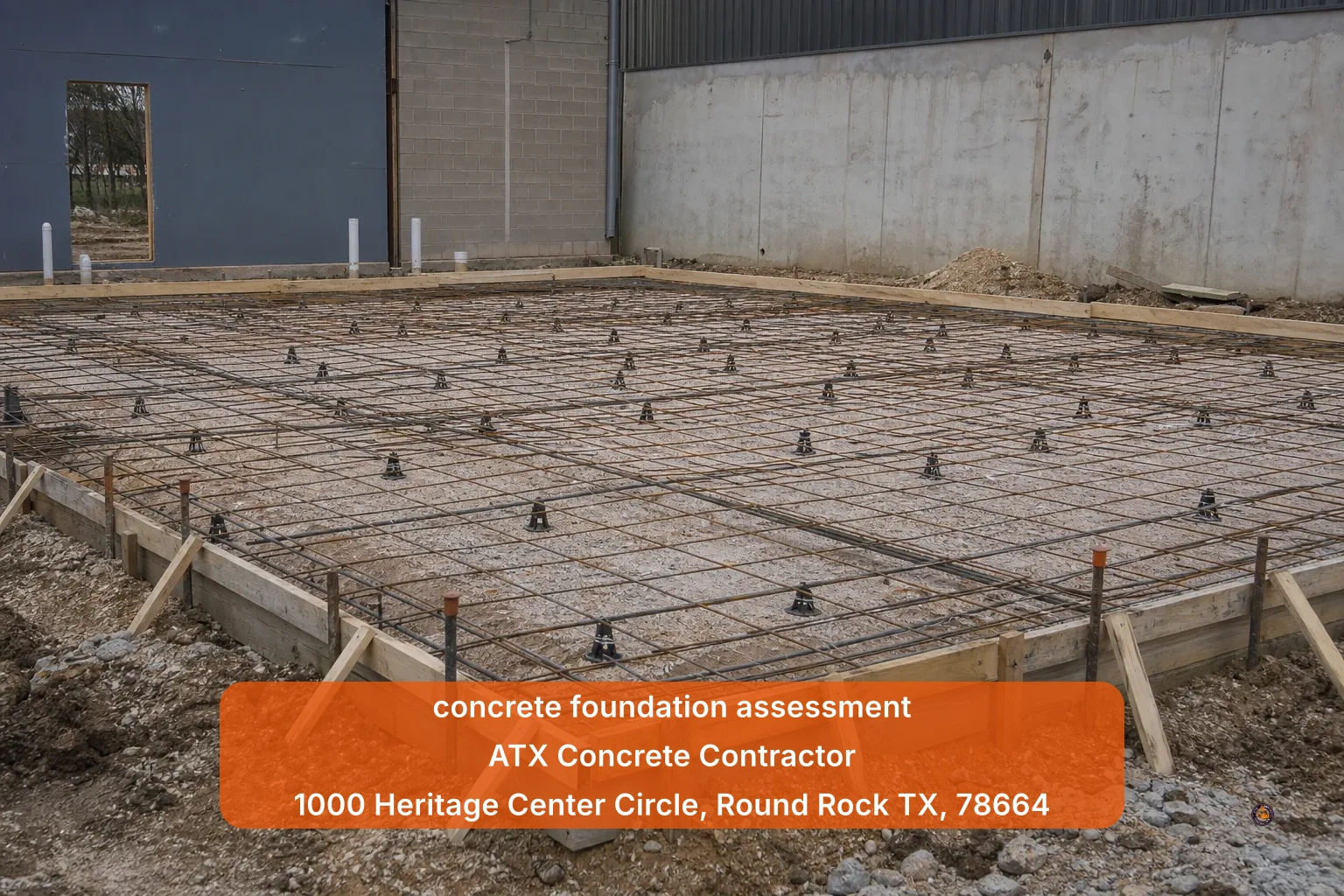
Before any concrete project, assess the soil and the base beneath the slab to ensure durability and prevent future issues. If you remember one rule about concrete foundation assessment in Austin TX, make it this: what sits under the slab decides how well the slab lives.
The myth to retire: a smooth finish equals a strong slab
A glassy trowel finish looks great on pour day. It tells you the crew cared about the last 30 minutes of work. It says nothing about the previous two days, where durability is won or lost. The fix is not a thicker slab or a higher-PSI mix. The fix is a base that is uniform, compacted appropriately for the soil and use, and drained so water has an intentional place to go.
If that sounds blunt, good. Too many projects chase cosmetics over fundamentals. When a homeowner asks a concrete contractor to “make it look perfect,” the right response is, “Let’s look at the base first.” Only then do finishes, sealers, and decorative choices make sense.
What the base actually does
“Base” is not just gravel under concrete. Think of the system beneath your slab as the load path that links your structure to the ground. Its job is to:
- Provide a uniform support so the slab is not overloaded in one area and slack in another.
- Manage moisture so the slab and subgrade are not cycling between saturated and bone-dry in unpredictable ways.
- Offer a stable working platform so the forms, reinforcement, and placement can be done accurately.
- Create a predictable environment so control joints and movement details work the way they are intended.
When the base does these jobs, your slab can do its jobs: hold loads, handle everyday use, and look good longer.
The part you can actually see: site context
You do not need a lab to notice useful cues before you call a concrete company near me. Walk the area after a rain. Look for: Standing water that lingers. Erosion channels or sediment fans where water has rushed across the site.
Evidence of past fill, such as construction debris mixed into the soil. Soft or pumping spots underfoot that feel different from adjacent ground.
Steep transitions where a slab edge might need special detailing to avoid unsupported areas.
These are observations, not diagnoses. They help you frame the right questions when you meet a contractor.
Five questions to bring to any foundation assessment
Use these to separate a surface-driven conversation from a durability-driven one.
How will you verify the subgrade is uniform? Ask what steps confirm that the bearing soils are consistent across the footprint. The right answer focuses on making the support uniform, not on pouring thicker concrete to mask a weak spot.
Where will water go, both during construction and after? Water that sits under or against a slab is a long-term problem. Useful reading: ACI’s note on the importance of drainage planning: ACI guidance on drainage around concrete.
What is the plan for a base course or other stabilizing layer, if needed? There is no universal prescription for thickness or material. The point is to create a uniform, stable platform.
If the proposal jumps straight to mix strength or finish options, you are skipping essential steps. How will joint layout relate to the site and the way the slab will be used? Joints control where cracks occur.
They do not prevent movement. A conversation about joint locations and spacing should track with slab size, use, sun and shade patterns, and access points.
What will be documented before the pour? Simple photos of site prep, notes on grading and base prep, and a sketch of joint layout are not busywork. They are your record that the invisible work received real attention.
Thickness, PSI, and other expensive distractions
Sometimes more section helps. Often it just means you are placing more concrete on the same weak support. Similarly, specifying a higher-PSI mix sounds like strength, but compressive strength numbers on a ticket do not fix a base that shifts with moisture or is not uniform.
Base first, then thickness and mix for the actual loads. That sequence respects your budget and your timeline.
Drainage is not an afterthought
Finishes get compliments. Drainage prevents callbacks. Ask specifically: What slope will move surface water away from slab edges and toward a safe discharge point? How will downspout outfalls, hose bibs, or irrigation overspray be kept from flooding the slab edge?
If the project is flush with existing grade on one or more sides, what is the plan for preventing water from trapping against the slab?
That is exactly why it belongs in the first conversation, not as a last-minute change order. For context, see ACI’s brief on drainage and site water considerations: ACI guidance on drainage around concrete.
Movement is normal. Planning for it is professional.
The goal is not to eliminate movement.
A short primer on why cracks appear and what you can do about them is here: Learn why concrete cracks and how planning reduces problems. Why Concrete Cracks In Austin Tx.
None of that planning works if the base is not doing its job. You cannot cut joints to control cracks in a slab that is settling unpredictably.
When to involve a foundation engineer
There are projects where a skilled foundation engineer is not optional. Examples include: Unusual loads or point loads. Significant elevation changes within the slab footprint.
Evidence of very soft, disturbed, or undocumented fill. Structures that must meet specific performance criteria.
A good builder knows when to bring in that expertise. If you want a straightforward explanation of what the engineer brings to the table, this resource is worth your time: Blueprint for Stability. The Importance of a Skilled Foundation Engineer: Blueprint For Stability The Importance Of A Skilled Foundation Engineer.
If you are trying to budget intelligently for that expertise, this companion piece helps frame the costs and value: Budgeting for Expertise. Understanding the Costs of Foundation Engineering: Budgeting For Expertise Understanding The Costs Of Foundation Engineering.
Apply the same discipline beyond foundations
This base-first rule is not just for new homes or additions. It applies to driveways, patios, and walkways.
Whether you want a broom finish, a stamped pattern, or a stained surface, start with subgrade, base, and drainage. Patios often sit at grade and collect run-off from adjacent lawns. If there is no plan for where water goes, you will be chasing spalling edges and slab movement instead of enjoying the space.
Sun and shade patterns matter. Joints and surface treatments should reflect how the patio heats and cools through the day. That planning still depends on a base that keeps the slab’s underside conditions as uniform as possible.
If you want a concise checklist of the big elements that must be aligned on any slab project, here is a plain-English explainer: Essential Guide to Concrete Slabs for Construction Projects. Concrete Slabs Essential Elements For Your Construction Project.
What a useful assessment looks like in Austin
Every property and project is different. Expect to cover at least: A look at existing structures for context. Doors sticking, cracks along repeated lines, or slab edges separating from flatwork nearby are clues that inform questions, not instant diagnoses.
A discussion about loads and use. Vehicle traffic, storage, and equipment change support requirements and joint planning. Access, staging, and traffic patterns. Pouring conditions affect quality. Planning how to place, finish, and cure without rushing is part of the result you see years later.
Project logistics that affect quality. Simple things like protecting prepared subgrade from rain ruts before pour day matter.
If a proposal jumps to color charts, stamp patterns, or sealer brands without covering these basics, bring the conversation back to the soil and base. Your surface choices will make more sense once the fundamentals are aligned.
How finish choices fit, once the base is right
Once you are confident in the ground support and drainage, finish becomes a smart decision rather than a coin toss.
Broom or trowel finishes. Choose for traction and how the surface will be used. A clean but lightly textured finish often balances usability and appearance.
- Decorative concrete. Staining and stamping are about expression and context. Edges and transitions must be detailed carefully so the finish is not undermined by chipping or raveling.
- Sealing and maintenance. Sealer choice should track with exposure to water and sun, not just sheen preferences. If you are weighing pros and cons, this guide on protecting your investment is a useful primer: Essential Guide to Concrete Sealing in Austin, TX: Concrete Sealing Protecting Your Investment In Austin Tx.
None of those choices upgrades a weak base. They only perform as well as what lies beneath.
The local choice is about accountability, not just distance
If you searched for a concrete contractor or a concrete company near me in the Austin area, proximity helps. Accountability helps more. That partnership gives you leverage if something is missed and confidence when work goes as planned.
ATX Concrete Contractor serves Austin and surrounding communities, including Round Rock, Cedar Park, Georgetown, Pflugerville, Kyle, Leander, Buda, Hutto, Lakeway, Manor, West Lake Hills, Rollingwood, Bee Cave, Lago Vista, Jonestown, Sunset Valley, and San Marcos. With over 15 years in the trade and more than 500 completed projects, our team has built a reputation for quality work and reliability backed by a 98 percent customer satisfaction rate. We emphasize high-quality materials, meticulous planning, and customer-focused service, and we offer free consultations with transparent pricing so you are informed before any work begins.
If you want a compact overview of how a properly poured foundation comes together step by step, this resource pairs well with the questions above: Building Blocks. The Importance of a Properly Poured Concrete Foundation: Building Blocks The Importance Of A Properly Poured Concrete Foundation.
A quick decision rule you can use this week
How will joint layout reflect the size and use of this slab?
A contractor who answers these clearly is already focused on the work that decides longevity. A contractor who cannot is focused on the finish. And a smooth finish means little if the base under the slab is wrong.