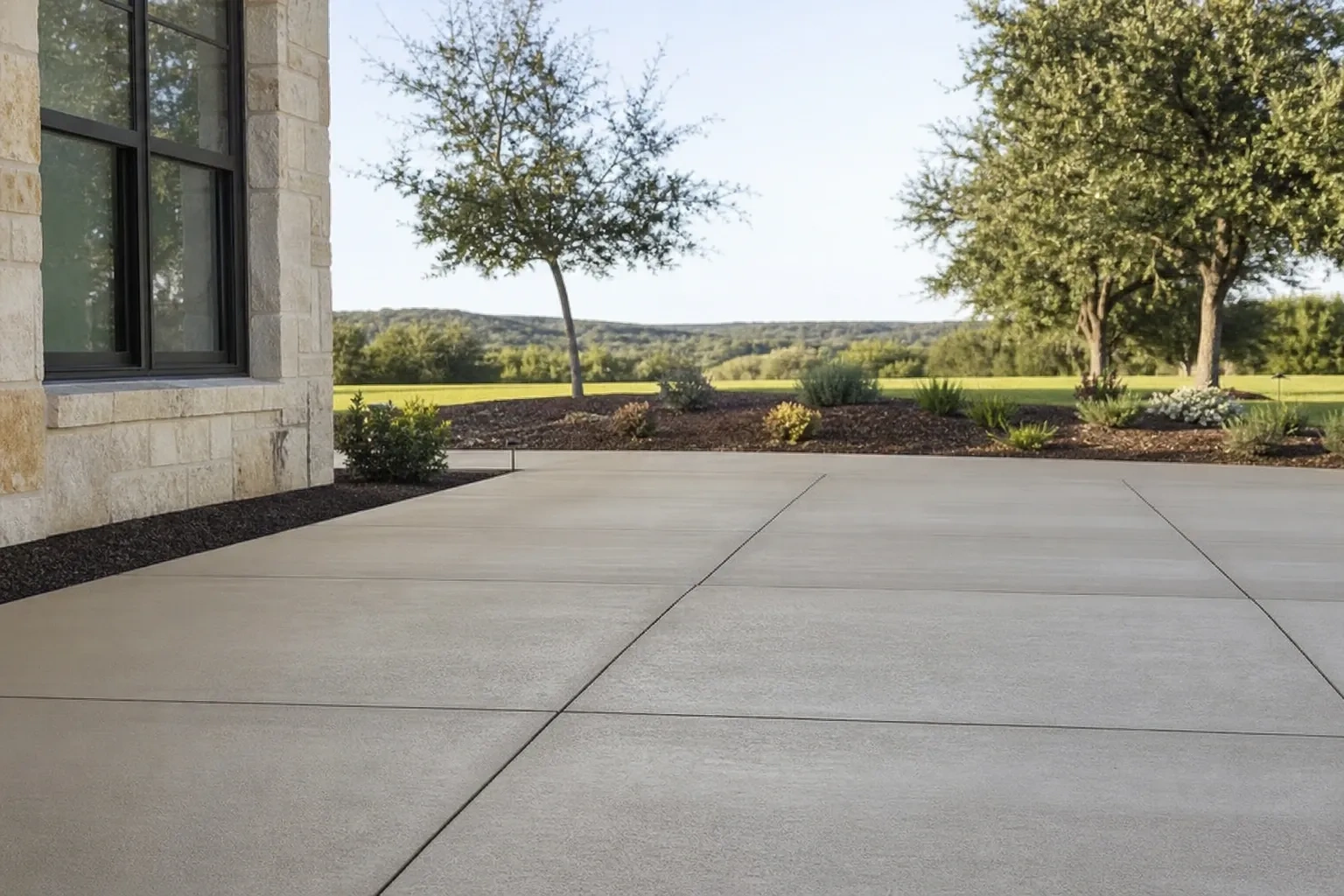
Properly spaced joints in concrete installations help manage stress and movement, reducing the risk of cracking over time.
The myth: “Fewer cuts mean a stronger slab”
We hear this a lot. It sounds logical, but it misreads how concrete behaves. Concrete shrinks as it cures, expands and contracts with temperature swings, and moves under loads. Joints are intentional, controlled planes where that movement can happen cleanly. Skip them or “space them out,” and the slab will usually create its own joints, random cracks.
Joints don’t weaken good concrete work; they protect it.
What each joint actually does
- Control (contraction) joints: These tell the slab where to crack in a straight, tidy line as it shrinks. On broom-finished driveways, you’ll see them as straight sawcuts. On stamped patios, they’re often aligned with pattern lines or borders.
- Isolation (expansion) joints: These separate a slab from something that shouldn’t move with it, like a foundation, post, drain, or stair. They’re typically filled with a compressible material so the slab can expand without pushing on that fixed object.
- Construction joints: Where one day’s pour meets the next. They’re planned edges, not “oops” lines, and they can be detailed to perform like control joints.
Each type has a job. The right combination keeps your driveway, patio, or sidewalk looking intentional rather than “cracked by surprise.”
Planning joints for Austin use-cases
A good plan accounts for how the space will be used, how the slab will be shaped, and what it touches.
Driveways. Wheel loads and turning movements concentrate stress. Joints should anticipate those paths and align with geometry changes, curves, apron transitions, and garage thresholds, so the slab doesn’t try to “write its own rules” later. Patios and pool decks. Furniture legs, grill stations, and planters create point loads. On decorative and stamped concrete, we align joints with the pattern or frame them into borders so function and aesthetics move together.
Sidewalks and walkways. Repeated foot traffic is predictable; tree roots and utilities are not. Isolation joints around posts, drains, and steps help the walkway move without binding.
Cuts aren’t a mistake, they’re a method
The cut is the joint. It’s selected and executed to create a clean, straight relief line without marring the finished surface. If you’re curious about method and timing in context, see our note on how concrete cutting creates effective control joints.
Stamped patios? Same idea. We simply hide the joint in the pattern or use it to define a border or medallion. Done well, you’ll notice the design before you notice the joints.
Joints and cracking: cause, effect, and expectation
Even excellent concrete can develop hairline cracks. That isn’t automatically a failure. The role of a joint is to decide where that inevitable movement shows up.
Two takeaways matter for homeowners and property managers: Decorative work still needs joints. Pattern, color, and texture don’t change the physics.
Drainage, thresholds, and other “quiet” details that shape joint layout
Joints don’t exist in a vacuum. The lines you cut (or form) should respect: Drainage and slope. Water needs a predictable path away from structures. Joints that follow slope breaks minimize ponding at the cut. Doors, steps, and edges. Align joints with thresholds and returns so transitions don’t telegraph stress into the slab.
Fixed features. Posts, skimmers, cleanouts, and AC pads should be isolated so the slab can move around them. Decorative goals. On stamped concrete patios and driveways, joint layout is part of the look, use it to frame pattern fields cleanly.
If you want to see where this kind of planning fits into a full project, explore our Austin, TX concrete services.
Maintenance: small habits, long payoffs
Joint planning starts before the pour, but care continues afterward. Simple, low-effort habits extend the life and appearance of your slab: Keep joints clean. Packed dirt and weeds can act like wedges. Watch isolation joints. If compressible filler deteriorates around posts or walls, ask about replacement before hard contact develops.
Limit heavy point loads at slab corners. Concentrated stress near a joint can chip the edge. Consider surface protection. In high-exposure areas, a maintenance plan that includes surface sealing can reduce staining and make routine cleaning easier. For broader care considerations, see our guide to concrete sealing in Austin.
None of this is complicated, but it is intentional, just like the joints.
How we approach joints across common ATX projects
ATX Concrete Contractor is a premier concrete contractor serving Austin and the surrounding communities, with over 15 years of experience and more than 500 projects completed at a 98% customer satisfaction rate. Our day-to-day work includes concrete foundations, driveways, patios, sidewalks and walkways, stamped and decorative concrete, pool deck installation and resurfacing, and concrete cutting and core drilling. That range matters because joint decisions connect to each service: Driveways. Patios and pool decks. On stamped and decorative concrete, we integrate joints with the pattern so performance and aesthetics move together.
Sidewalks and walkways. We plan joint spacing and isolation around steps, utilities, and landscaping to avoid binding.
If you have a driveway, patio, sidewalk, or pool deck on the horizon, make joint placement part of your first conversation, not a punch-list item after the pour.