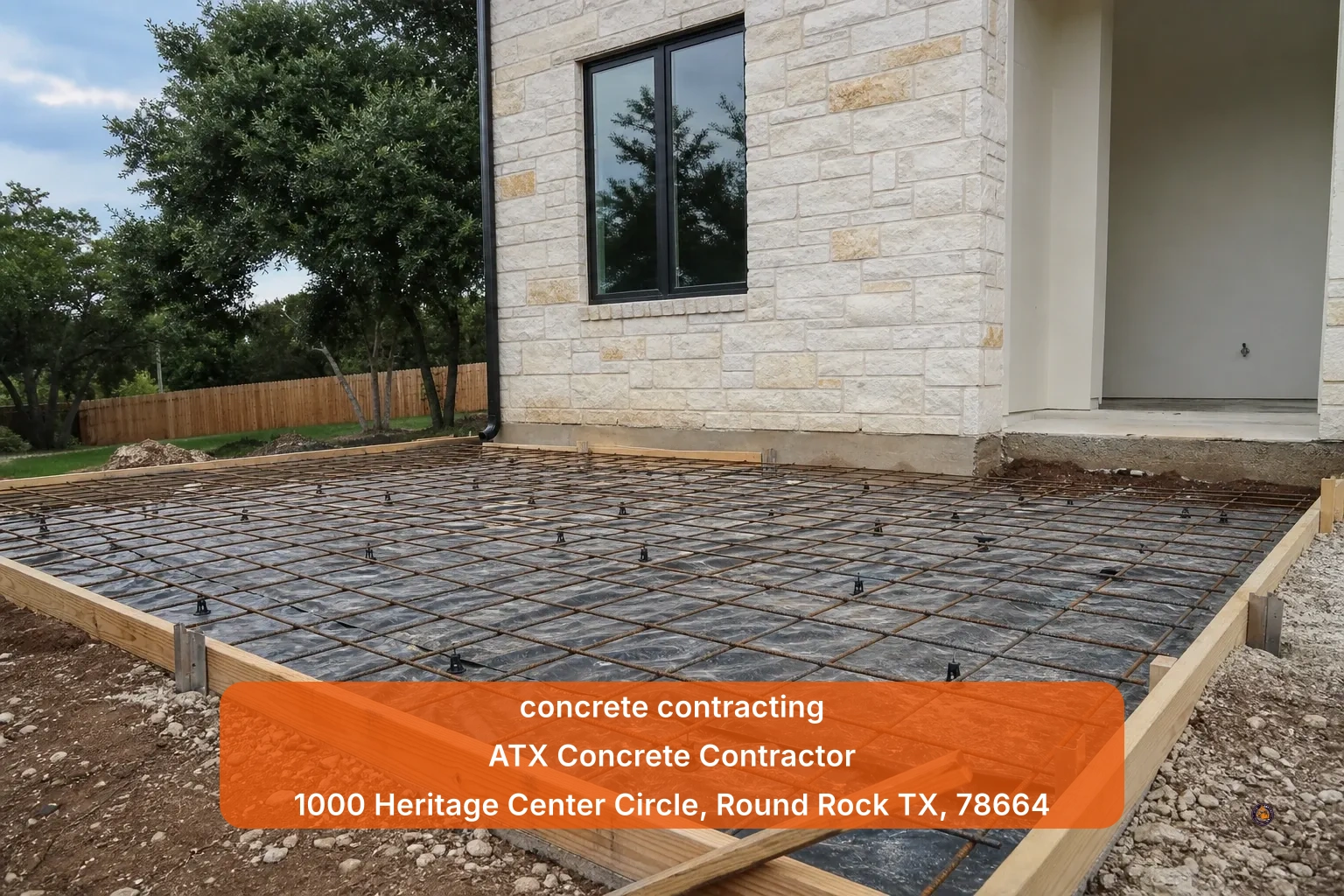
To ensure a lasting concrete installation, always confirm that essential prep work is included in the bid before making a decision. In concrete contracting Austin TX homeowners can trust, the cheapest number often hides the most expensive omissions.
Why low numbers fall apart after the pour
Most concrete failures trace back to what happened before the ready-mix truck showed up. It is a change order waiting to happen, or worse, an early crack, a settled panel, or a driveway that holds water.
The scope items that decide durability and cost
When you ask for a proposal, ask every concrete contractor to write down exactly what happens before and after the pour. At minimum, you want clarity on these topics:
Site access and surface protection. How will crews access the work area, and what will they protect along the way? Fences, irrigation, landscaping, and hardscape near the path of equipment are often affected. If access is tight, the plan and time required change the price. Demolition and haul-off. What gets removed, how it will be broken (sawcutting versus mechanical), who hauls debris, and where it goes. If only “demo included” appears on a bid, that leaves room for expensive surprises when the first load heads to the landfill.
Utility locating. Who is responsible for calling in locates, and how private lines on your property will be identified. This is a small line item with big consequences if skipped. Subgrade evaluation and correction.
Base material and compaction. What base will be used, how thick it is planned to be, how it will be compacted, and how the crew will verify density. For background on why base matters, see our plain-English explainer, “Is gravel needed under concrete,” which unpacks the role of a compacted base beneath slabs and flatwork Is Gravel Needed Under Concrete. Drainage and slope.
Formwork and elevations. What reference points determine the finished height, and how forms will be set to achieve those elevations consistently across the slab. Reinforcement, if required by design. If mesh, bars, or fibers are part of the plan, the proposal should say so. If not, it should say what the slab relies on instead. Do not accept vague phrases like “as needed” without a reason.
Joint plan. Where control joints will be placed and how they will be made (tooled during finishing or sawcut after set). Joint layout is one of the most effective tools to manage where cracks form.
If there is no joint plan, that is a problem. Mix, placement, and finishing methods. You do not need a spec book, but you do need to know how the crew plans to place, strike off, float, and finish the surface you are paying for, and when the surface will be ready for foot or vehicle traffic.
Curing approach. Curing affects strength development and surface quality. Ask what curing method will be used and how long the slab should be protected from traffic and sprinklers. There is no universal duration that fits every job, so the plan should reflect your site, weather, and finish. Cleanup and washout management. Where will concrete washout be contained and how will the site be left at the end? This item is often skipped in low bids and then shows up as a fee on pour day.
Each bullet may look like a small detail. Together they are the difference between a slab that behaves and one that becomes a maintenance project. For a deeper look at why cracks show up in the first place, read Why Concrete Cracks in Austin TX Why Concrete Cracks In Austin Tx
The Austin reality: site variables that move numbers
None of these variables are “extras.” They are the job. If they are missing from a proposal, the price you see is not the price you will pay.
How to compare quotes the way pros do
When you have two or three proposals in hand, do this before you look at the bottom line:
Put the scope paragraphs side by side. Is demolition defined? Is subgrade correction written down? Is base listed by material and approach? Are elevations and joint layout named? Highlight every sentence that starts with “as needed” or “if required.” Those phrases are placeholders for cost and responsibility. Ask each bidder to convert them into specific tasks or to explain what decision rule they will use on site.
Circle omissions. You want apples-to-apples scopes before you ever talk dollars. Ask who is doing what after the pour. Who handles sawcuts if they are planned? Who protects fresh concrete from pets and sprinklers? Who removes forms? Who fixes turf or beds next to the forms?
Confirm the schedule and sequence. When will demo occur, when will forms go when is the pour, and when will the site be walkable and drivable? A schedule with gaps invites weather and access conflicts that cost time and money.
This approach works for patios, pool decks, sidewalks, and foundations, and it is crucial for driveway work.
Red flags in a “too good to be true” bid
A sharp price is not automatically a red flag. Watch for:
One-line scopes. No demolition plan.
No base, no compaction. “Prep included” without naming the base or compaction approach is not enough to control settlement. Silence on drainage and joints.
Vague protection and cleanup.
Special note on cutting, dust, and neighboring surfaces
Any proposal that includes sawcutting, coring, or grinding should explain how dust and slurry will be controlled and how nearby glass, vehicles, or finishes will be protected. The right approach depends on the task and your site. It is reasonable to ask for a simple description of the controls and cleanup you can expect.
For patios in Buda, Hutto, and Round Rock, the same rule wins Scope before price. Decorative textures and colors are finishes. They do not replace base, compaction, or a joint plan.
If you are new to the prep conversation, start with our plain-language primer that answers a common question directly: Is gravel needed under concrete. You will see why base type and compaction show up in scopes that last Is Gravel Needed Under Concrete
What a clear, Austin-ready scope sounds like
You do not need an engineer’s spec. You do need plain words that cover:
The tasks they will perform before the pour. Demolition method, subgrade correction, base and compaction, formwork and elevations, reinforcement if part of the plan, and the joint layout.
The pour day plan. Placement method, finishing expectations, start and end times, and how neighboring areas will be protected. The after-care. Curing approach, when you can walk and drive on the surface, and who returns to remove forms or cut joints.
The cleanup. Where washout will be contained, what hauling is included, and how disturbed areas will be left.
How this helps you even if you do not choose us
A better scope does two things for you. First, it protects your budget: problems get solved on paper before they get billed on site. Second, it protects the outcome: water moves where it should, joints control cracks more predictably, and the surface stays supported.
ATX Concrete Contractor has spent more than 15 years earning a reputation for quality across greater Austin, completing over 500 residential and commercial projects with a 98 percent customer satisfaction rate. We emphasize high-quality materials and a meticulous approach, and we back our concrete work with a 100 percent quality guarantee. We also keep pricing transparent. That starts with free consultations and estimates that spell out the scope so you can compare proposals on the merits, not just the math.
If you take nothing else from this piece, take this checklist to your next conversation:
Ask every bidder to write down what happens before the pour. Confirm where water will go and where joints will go.
Require a line for demolition, haul-off, base, compaction, curing, and cleanup. Turn “as needed” into “we will do X if Y is observed, and here is the cost.”.
Compare scopes first. Then compare numbers.
That process will save you time, prevent surprises, and deliver a slab that behaves the way you expect, whether you are hiring a concrete company near me for a small patio or a commercial flatwork crew for a more complex pour in Austin.
For a broader view of cracking mechanics and realistic expectations for concrete in our area, revisit our guide on Why Concrete Cracks in Austin TX Why Concrete Cracks In Austin Tx This knowledge empowers you to make informed decisions, ensuring your project is completed to the highest standards. Remember, the lowest bid can sometimes lead to the highest costs if the necessary preparation work is overlooked. Prioritize quality and clarity in your proposals, and you'll set the stage for a successful concrete project.