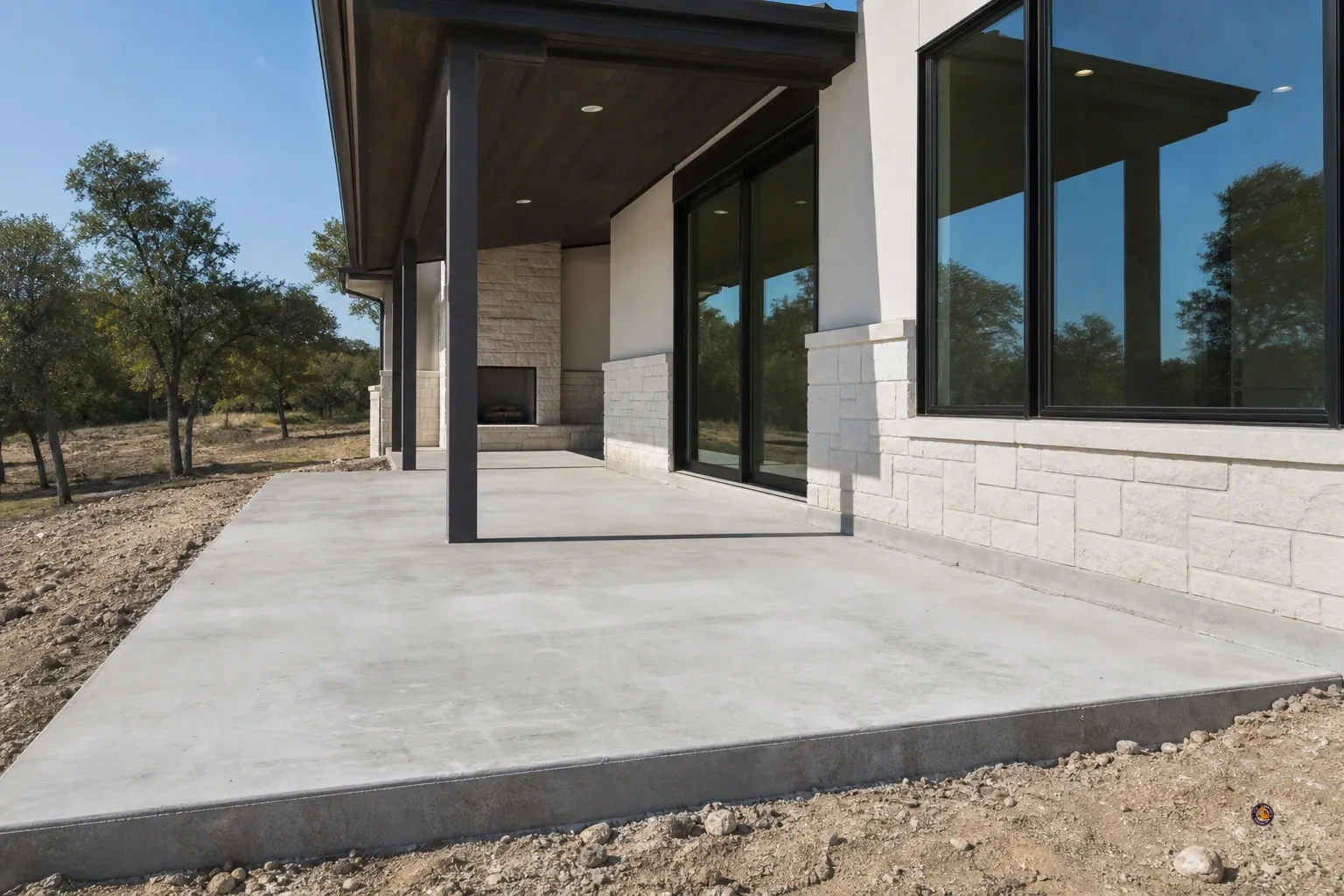
The durability of concrete slabs is primarily influenced by material quality, environmental conditions, and proper installation techniques. Durability in a concrete slab comes down to three levers: the materials you place, the conditions they face, and how the work is executed.
Myth to retire: A mirror-smooth finish equals a strong slab
A troweled, glassy surface tells you the crew cared about the last hour of the job. It says nothing about the two days of decisions that actually determine service life: base preparation, drainage planning, joint layout, and curing discipline. That is where slabs earn or lose decades.
If you take one thing from this piece, let it be this: judge the work you cannot see yet. The sleek finish is a result, not a cause, of durability.
What material choices affect longevity?
Concrete is a recipe, not a commodity. Two loads can both be “concrete” and behave very differently after placement.
- Mix suitability. The right proportions of cement, aggregates, and admixtures must match the project’s use and exposure. A slab that will see parked vehicles, forklifts, or constant wetting calls for different performance priorities than a garden path. Stronger is not always better if shrinkage, set time, or finishability are wrong for the job.
- Aggregate quality. Clean, well-graded aggregate supports strength and reduces shrinkage. Dirty or poorly graded rock introduces voids and weak planes.
- Admixtures. Set accelerators, water reducers, and air-entraining agents all have a place, but the plan must be deliberate. Using admixtures to solve a scheduling problem instead of a performance requirement often backfires on durability.
Owner takeaway: When you interview a concrete contractor, ask what will be in the mix and why. Look for an answer that ties materials to how the slab will be used, not just a claim about “high PSI” or “premium cement.”
How do site and drainage decisions shape slab life?
Subgrade uniformity. Concrete wants consistent support. Soft pockets, organic material, and variable compaction create stress risers that encourage cracking and differential settlement.
Base course selection and prep. A well-prepared base distributes loads and reduces subgrade pumping. If you are weighing options under your flatwork, this explainer on whether gravel is needed under concrete lays out how base layers influence slab performance.
Positive drainage. Slabs that trap water at edges or invite backflow from beds and lawns age faster. The American Concrete Institute highlights drainage as a core design consideration. See ACI’s summary on why correct drainage planning matters.
Owner takeaway: Do a dry-run walk. Trace the path water will take off the slab, at the edges, and underneath. If the plan is “we’ll see how it looks after the pour,” you do not have a plan.
What installation actions separate a long-lasting slab from a short-lived one?
Even a perfect mix fails under poor placement practices. The sequence and timing of tasks on pour day determine how the slab will behave for years.
Formwork and isolation. Clean, tight forms and proper isolation around posts, walls, and utilities reduce restraint and uncontrolled cracking where geometry changes.
Reinforcement placement.
It must be supported in the correct zone of the slab. Steel left on the dirt or sitting at the surface is decorative, not structural.
Jointing. Layout and timing. Control joints tell concrete where to crack. They need to be planned around slab shape, thickness, and use, and cut at the right time. Random, shallow, or late joints do not work.
Finishing discipline. Overworking the surface or finishing while bleed water is present weakens the top layer, inviting scaling and early wear. A good finish protects what proper prep already achieved; it cannot fix a bad base or poor drainage.
Curing. Concrete needs moisture retention to develop its designed properties. Curing is not a single “spray and pray” pass; it is a managed period that matches the mix and site conditions. For a concise overview, ACI’s guidance on concrete curing fundamentals reinforces why method and duration must be project-specific.
Owner takeaway: Ask how curing will be handled and for how long, what triggers sawcutting, and how reinforcement will be supported. Vague answers here correlate with callbacks later.
Are cracks always a sign of failure?
No. Concrete shrinks as it hardens, and cracks are the mechanism it uses to relieve internal stress. The goal is predictable, controlled cracking that is tight and aligned with the joint plan.
When to worry. Wide, offset, or growing cracks, repeating patterns that mirror subgrade defects, and cracks accompanied by settlement or heaving deserve prompt evaluation.
When to document and monitor. Stable hairlines that follow control joints or appear soon after placement often reflect normal behavior. Keep notes and photos, then revisit after seasonal changes and initial loading.
If you want to see a deeper treatment of causes and prevention specific to our market, read our primer on why concrete cracks in Austin.
Does thicker concrete automatically last longer?
Not automatically. Thickness must match the load and be paired with uniform support, correct jointing, and proper curing. Increasing thickness on top of poor subgrade prep or bad drainage simply preserves the underlying problem in a heavier slab.
Owner takeaway: When someone quotes a single line item like “we’ll pour it thicker,” ask for the companion details: base prep method, joint plan, reinforcement support, and curing approach. Durability is an ensemble, not a solo.
Will sealing or polishing make my slab more durable?
Surface treatments do not correct structural shortcomings, but they can protect the wear layer. Sealers limit moisture and stain intrusion and make cleaning easier. Polishing densifies and refines interior slabs to resist abrasion. Neither replaces the need for a sound base, good jointing, and proper curing, and neither will stop a structural crack.
If you are choosing a finish, select it for the real use case: foot traffic, vehicles, outdoor exposure, and cleaning expectations. A broomed outdoor finish trades sheen for grip and weather tolerance. A polished interior finish prioritizes abrasion resistance and low maintenance.
How do heat, rain, and use affect the durability of concrete slabs in Austin, TX?
Owner takeaway: Plan for the environment your slab will actually live. Ask how the crew will adapt if temperatures shift or a storm is forecast, what protections are in place if rains arrive after placement, and how early use will be limited to avoid imprinting damage or curling risk. Your contractor’s answers should address both scheduling and technical adjustments, not just “we’ll work fast.”
What should I check before I approve a bid from a concrete contractor?
If you are comparing proposals from a “concrete company near me,” line up the scope details side-by-side. Price without process is the most expensive option you can buy.
Ask each bidder to answer, in writing, the following. Subgrade and base. How will unsuitable soils be identified and handled? What base material and thickness are proposed, and how will support be made uniform across the slab?
Where will the finished slab elevation sit relative to surrounding grade to direct water away?
Mix and placement. What mix will be used and why is it suited to this application?
What is the plan to avoid on-site water addition and handle placement if conditions change?
Reinforcement and joints. What reinforcement is planned, and how will it be supported to stay in the correct position?
Where will control and isolation joints be placed, and when will sawcuts occur?
Curing and protection. Which curing method will be used and for how long?
How will the slab be protected from premature loading, rain, or high winds during early age?
Cleanliness and site care. Where will concrete washout be contained so it does not contaminate landscaping or drains?
How will the site be left at the end of each day?
When a scope answers these questions clearly, you can trust the team understands that the durability of concrete slabs is built on decisions that start before the first truck arrives.
Planning a patio, driveway, or addition? Start with the slab essentials.
For a concise checklist of those fundamentals, our walkthrough on the essential elements for concrete slabs lays out how each step fits together.
Quick answers to common PAA-style questions
Do control joints weaken a slab? They tell the slab where to relieve stress. Properly placed and cut, they improve performance by making cracks predictable and manageable.
Does rebar stop cracking? No. It limits crack width and helps distribute loads, making cracks less noticeable and the slab more resilient under service.
Can I pour over an old slab for durability?
It depends on the existing slab’s condition, movement history, and drainage. Overlays amplify whatever is underneath. If the base problem remains, so will the symptoms.
Does higher PSI guarantee longer life? Only if the mix design, placement, curing, and support are right for the job. A mismatched high-strength mix can be more prone to shrinkage cracking if handled poorly.
Is a broom finish less durable than a trowel finish? Durability is about the substrate and curing; finish texture is chosen for use and safety. Outdoors, a broom finish often serves you better by adding traction and tolerating weather.
How owners can influence outcomes without over-engineering
You do not need to specify every detail to get a durable slab. You do need to insist on clarity about the invisible steps that matter most. Here is a simple, non-technical approach that keeps you in control:
Observe water pathways. If the team cannot answer confidently, pause.
Prioritize uniform support. Ask what will be done to remove soft spots and create consistent base conditions. Uneven support is a durability killer.
Respect the joint plan. Request a simple sketch showing joint layout and sawcut timing. A plan on paper usually yields a slab that behaves on purpose.
Make curing visible. Agree on a curing method and the moment it begins. If you cannot see curing happening, it probably is not.
Limit early use. Clarify what loads and traffic are acceptable at specific milestones. Be conservative. Early abuse leaves permanent marks.
For additional context on base layers and drainage decisions, this discussion on whether gravel is needed under concrete is a practical companion to the jointing and curing guidance above. And when you want a single-page refresher before your next project meeting, refer to our essential guide to concrete slabs for construction projects. If cracks or surface changes are already on your mind, our local explainer on why concrete cracks in Austin will help you separate symptoms from causes and decide what to do next.
Sources for further reading: The American Concrete Institute outlines why project-specific drainage planning is essential to slab performance. See their note on drainage considerations around concrete.
For curing fundamentals and why method and duration depend on the project, ACI’s resource on concrete curing is a reliable reference.