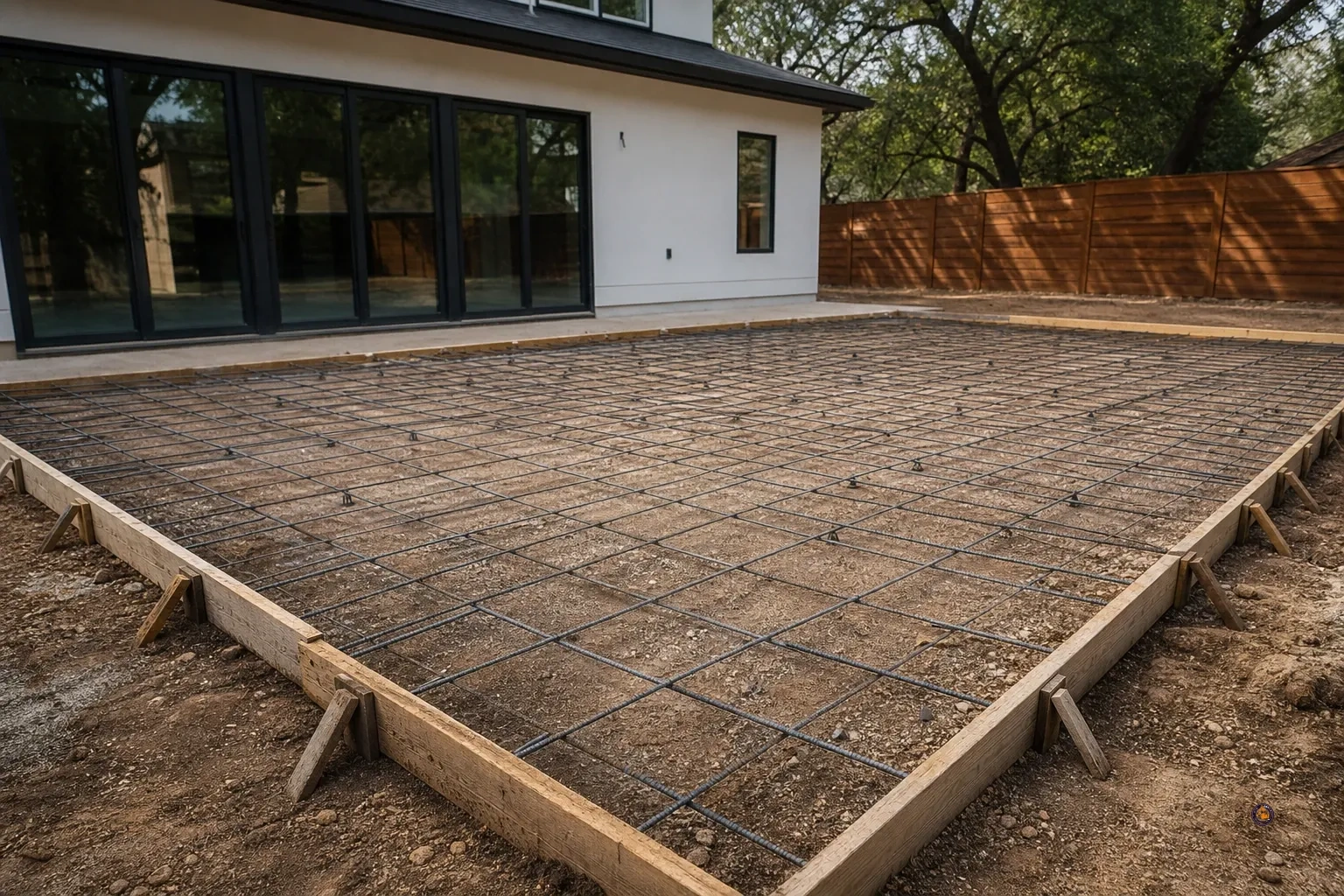
Assessing soil conditions is essential before any concrete work begins; a stable base is crucial for durability. Assess the soil and base before you talk about concrete finishes.
The myth to retire: a smooth finish makes a strong slab
A glassy trowel finish tells you the crew cared about the last 30 minutes. It says nothing about the previous two days, which is where durability is won or lost.
If you are searching for concrete foundation assessment, start with what sits under the slab, not what will be visible on top of it.
What the base actually does
Think of the base and subgrade as the load path from your structure to the ground.
Distributes loads so wheels, foot traffic, and columns do not punch through soft spots.
Manages moisture by shedding surface water and interrupting capillary rise from below. Provides a uniform platform so the slab moves predictably, which lets control joints do their job.
When these three jobs are handled, your finish choices can focus on function and look. When they are not, the slab decides for you.
Why Austin projects make base work non-negotiable
Start with drainage, use, and access. Then pick finishes.
The American Concrete Institute highlights that drainage is a project-specific design consideration, not a one-size-fits-all prescription. See ACI’s note on drainage considerations for concrete.
What belongs in a real soil and base assessment
Bearing verification. How is the subgrade’s bearing capacity established or verified for this use, and at what locations will it be checked?
Moisture path. Where does surface water go today, and where will it go after the pour? What grading or drains make that happen? Uniformity plan. How will soft pockets be identified and corrected so the slab sees a consistent base?
Base materials. What base material is proposed and why that gradation for this site and use? If fines are present, how will moisture be managed? Compaction method and checks. What equipment is planned for compaction, and what will confirm it was achieved consistently?
Separation from ground moisture. Will a capillary break or other measure be used where chronic dampness is expected, and how does that interact with the intended finish? Jointing strategy tied to use. Where will control and isolation joints go based on geometry and loads, not just a rule of thumb?
Movement and edges. How will transitions at garage slabs, thresholds, and utility penetrations be detailed so they are not stress risers?
None of these items are decorative. They are the difference between a surface that stays usable and one that telegraphs base problems as cracks, spalls, and uneven settlement.
For an overview of how structure and daily use meet in practice, see our page on Concrete Foundations & Slabs.
Finish last: how looks tie to use, not strength
Pick a finish for safety, comfort, and maintenance, not “more strength.” Examples:
The finish enhances usability. The base determines whether the finish has a chance to do its job.
Three common misconceptions, and better questions to ask instead
“We can pour thicker and call it good.”. Better question. What verifies the bearing capacity at the weakest spot, and how is uniform support achieved across the entire footprint?
Better question. Where will the slab be allowed to crack in a controlled way, and how will base uniformity and joint layout make those cracks predictable?
“A good sealer solves moisture.”. Better question. How will bulk water and capillary moisture be managed below and around the slab? What is the plan for long-term drainage maintenance? For context on what causes movement and surface issues locally, read why slabs move in our post on why concrete cracks in Austin.
What this means for real projects across Greater Austin
- Concrete patio installation Round Rock TX or Hutto TX: The patio’s most-traveled paths and where tables cluster should drive compaction access, base thickness transitions, and joint placement.
- Concrete patio installation Buda TX: Ask how joint layout and base uniformity help the slab move without telegraphing stress to the surface.
- Commercial entries and service lanes in Austin: The base needs to anticipate that, not just the center of the slab.
These are use cases, not exceptions.
Trending ideas that actually improve slab performance
Trends are only useful when they connect to how your slab will perform for years. Here are approaches owners are asking about and why they matter. Use them where they solve a real problem.
Capillary breaks under slabs. A layer of clean, well-graded aggregate can reduce upward moisture movement and help the base drain laterally. Before you pick an approach, it helps to understand when and why base layers are used. See our explainer on whether gravel is needed under concrete.
Intentional water paths. French drains, curb cuts, or surface grading that make it obvious where water goes in a storm. The benefit is not just dryness. It is keeping fines from pumping and softening the base at slab edges. Smarter jointing, fewer surprises. Owners are leaning into joints that align with architecture and use patterns instead of fighting them visually. The gain is predictable movement hidden in plain sight.
Repair scopes that start with subgrade. For localized settlement or trip hazards, cutting and replacing only the panel is not a plan unless you address why that panel lost support. Scopes that stabilize the base beyond the visible defect last longer. Finish choices tied to care. Many owners want low-maintenance surfaces rather than high-gloss. Align texture and sealer choice with how you will clean it and how it will age in sun and rain.
A trend worth following is one that makes your slab easier to live with, not just better looking on day one.
The quick field checklist: what to look for before finishing talk begins
Bring these observations and questions to any concrete contractor or engineer before you discuss colors or stamps:
Where does water collect now after a typical rain? After a heavy rain?
Are there visible soft spots, rutting, or areas that stay damp days longer than others? How will equipment access the work area to compact the base uniformly, especially in backyards with limited gates?
What is the plan to separate the slab from adjacent structures so each can move without stressing the other? How will the team confirm uniform compaction, not just the number of passes?
Where are control joints planned relative to re-entrant corners, steps, and changes in width? What is the plan at slab edges that meet landscaping or asphalt so those edges do not unravel?
These questions do not turn you into an engineer. They make it clear you expect the invisible work to be defined, not assumed.
How to compare bids the smart way
The lowest number is sometimes just the bid that skipped the base work. Scope before price:
Look for explicit grading and drainage tasks with a destination for water.
Expect base material type and target compaction to be named, plus how compaction is checked. Confirm access and logistics are accounted for so equipment can reach the work area without cutting corners.
Require a joint plan that matches the slab geometry and use, not a one-line note.
You are not being picky. You are protecting the part of the project that decides how long it will last.
When a finish is the right tool
There are times the finish is the right focus. Cured, well-detailed slabs benefit from sealers where staining or freeze-thaw exposure matters. Patios and sidewalks may call for a texture change for grip. Interiors can be polished for reflectivity and low maintenance. Start with the base. Then choose the finish that supports how the space will be used and cleaned.
If you want a deeper dive into how structure and appearance meet, browse our guide to Concrete Foundations & Slabs.
One last, practical rule for Austin owners and managers
If that conversation is thin, you are not ready to pour. When it is clear and site-specific, you can choose any finish with confidence, from a simple broom texture to a decorative surface, knowing the groundwork is set to support it.
For related context on movement and maintenance decisions as your slab lives in the weather, our post on why concrete cracks in Austin is a useful primer.