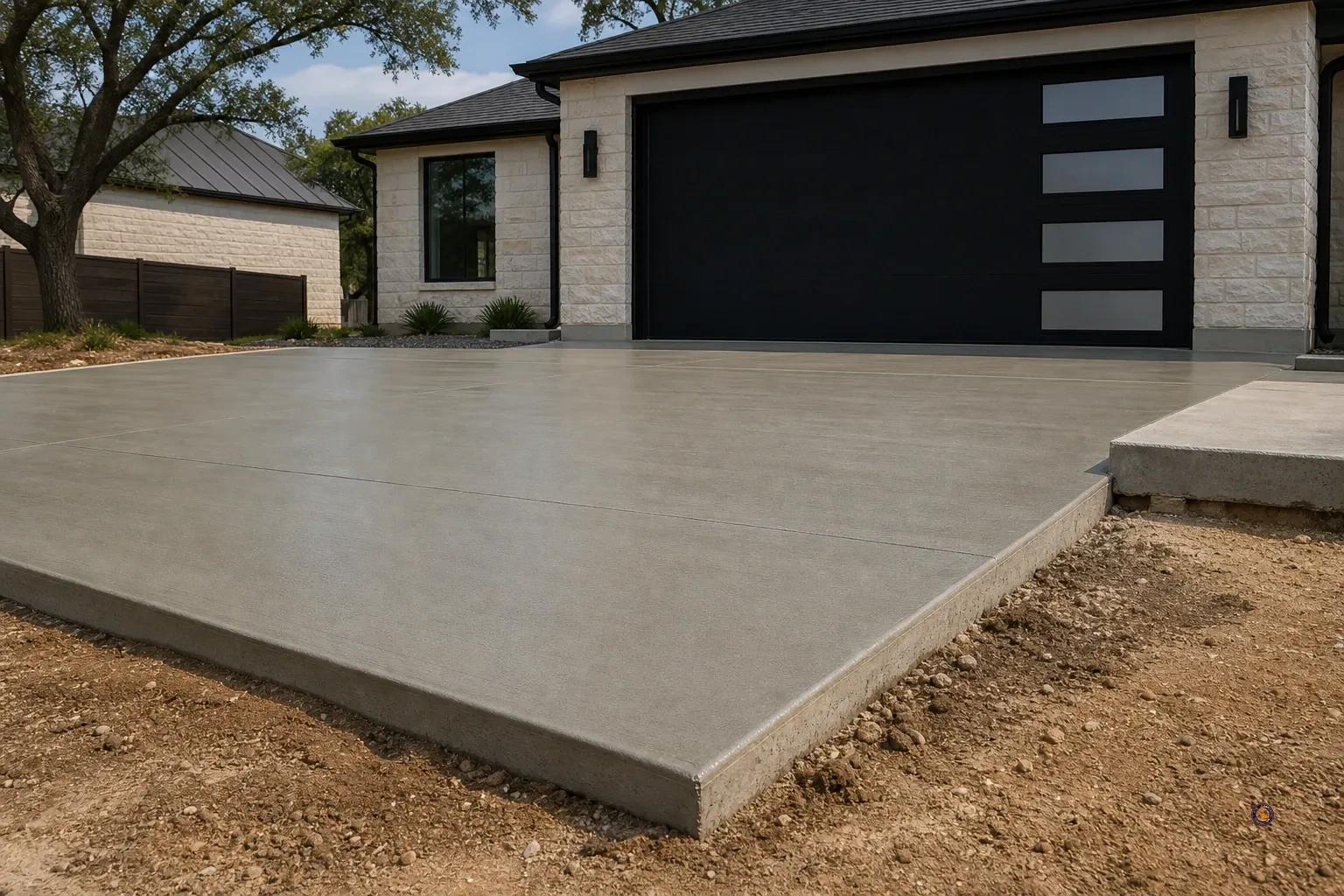
Before any concrete project, assess the soil and base conditions to ensure durability and stability. If you are searching for concrete foundation assessment Austin TX, start with what sits under the slab, not what will be visible on top of it.
The myth to retire: a smooth finish means a strong slab
A glassy trowel finish tells you the crew paid attention at the end. It does not tell you how the subgrade was prepared, whether the base is uniform, or where water will go. Strength and longevity are decided by the invisible work under the forms.
That is why two slabs can look identical on pour day and perform very differently a year later. One keeps its elevation and sheds water. The other settles at utility crossings, telegraphs cracks where the base changes, or scales at the surface because trapped moisture cycles through freeze and heat.
What the base actually does
Distribute loads. The base is the load path from traffic and structures into the ground. If that path is uniform, a slab moves predictably. If it is patchy, loads concentrate and the slab responds in kind.
Manage moisture. Water must have a planned route away from and around the slab. The American Concrete Institute highlights that proper drainage is a fundamental consideration for concrete performance.
See ACI’s note on drainage in its FAQ for context: ACI guidance on drainage around concrete.
Provide a consistent platform. Concrete shrinks and expands with temperature and moisture changes. A uniform base lets those movements happen where you expect them, typically at control joints, rather than as random cracking.
What a foundation or slab assessment should focus on in Austin
Whether the project is a new foundation in Austin, a concrete patio installation Hutto TX homeowners are considering, or concrete driveway repair near Round Rock, the underlying questions are the same:
How is bearing capacity verified on the prepared subgrade?
- Where will water go during storms and irrigation events, and how will surface grading and adjacent landscapes keep water away from the slab?
- What existing conditions could create weak spots, such as utility trenches or undocumented fill, and how will those areas be treated so they do not settle later?
- How will the jointing plan relate to the slab’s layout and expected loads so normal movement is controlled and cracks are guided where they do the least harm?
None of these are cosmetic. They are the difference between a surface that stays usable and one that forces you into early repairs.
If you want a deeper look at the structural role a slab plays, review our overview of Concrete Foundations & Slabs. It explains the types of projects we deliver across residential and commercial settings in Austin and surrounding communities.
“We can pour thicker and call it good” and other misconceptions
Here are common beliefs we hear, with better questions to ask instead.
“A thicker slab will solve a soft base.” Better question: What verifies the bearing capacity of the base and subgrade before forms go? - “More reinforcement makes the slab stronger everywhere.” Better question: How does reinforcement work with the joint layout to manage expected movement, and how does the base preparation keep loads uniform?
“Sealer will protect against cracks.” Better question: What is the plan for drainage, moisture, and joints so the slab’s natural movements happen predictably? Sealers can protect surfaces from staining and weathering, but they do not stop movement. - “Compaction is only for big commercial jobs.” Better question: How will you achieve and verify a consistent base on this specific footprint, including tight side yards, patio additions, and driveway widenings?
These are project-by-project answers. There is no one number or one mix that fits every site. That is why a quality assessment comes first.
For additional context on how and why concrete cracks, read our local explainer: Why Concrete Cracks in Austin TX.
Finish last. Performance first.
Finish selection is a good conversation to have once the base plan is clear and documented. Stamped concrete patios and driveways, polished floors, stained surfaces, or a clean broom finish are all in our wheelhouse. But a pretty surface cannot correct an uneven base, ignore drainage, or overcome poorly compacted trench backfill.
If your project involves decorative choices, make sure those conversations happen after the site assessment. For example:
Concrete patio installation Buda TX homeowners are planning often involves converting turf or decomposed granite to a usable hardscape. The key variable is the transition from loose surface to a uniform, compacted base that will not pump water back into the slab.
Concrete patio installation Round Rock TX residents request frequently adds to existing slabs. The joint between old and new must be handled intentionally, and the new base must not mirror the old slab’s voids or soft spots. Concrete driveway repair near Round Rock runs through utility crossings and curb transitions. The work is not just a surface patch. It is a plan for the base under the repair so you are not chasing the same depression next season.
What to ask your concrete contractor before a pour
Use these four questions to keep the conversation focused on performance. They apply to new foundations, patios, sidewalks, driveways, and commercial flatwork.
How do you confirm the base is uniform across the footprint, including at edges and around penetrations? Where does water go during and after a storm, and how does the grading and adjacent landscaping keep water away from the slab (See ACI concrete guidance?
What is the joint plan relative to the space’s layout and expected loads, and how will that plan be communicated on the drawings before the crew mobilizes? How will you treat areas of disturbed soil, such as utility trenches or recent excavation, so they do not become settlement lines?
These questions do not tell your contractor how to do the job. They make space for the right plan to be written down and followed.
Why this matters for homeowners and property managers
Lower lifetime cost. Spending time on the assessment often saves money compared to overbuilding thickness or chasing surface fixes later. Better aesthetics for longer. Decorative concrete only looks good when movement is predictable and moisture is managed. That is a base and drainage story, not just a finish story.
Fewer disruptions. When the plan addresses access, staging, and site-specific constraints up front, crews can work efficiently with less impact on daily use. ATX Concrete Contractor’s marketing emphasizes quality craftsmanship, safety protocols, and minimal disruption during execution, and in our experience that starts with a solid plan for the base and site logistics. Confidence in decisions. A written scope that explains how the subgrade and base will be prepared, how water will be handled, and how joints will be placed gives you something concrete to approve before work begins.
If you are comparing options for patios, driveways, or additions, our article on base materials is a helpful primer: Is gravel needed under concrete.
The ATX Concrete Contractor perspective on getting it right
We are a premier concrete contractor serving Austin and nearby cities such as Round Rock, Buda, Hutto, Georgetown, Cedar Park, and San Marcos. Our team delivers residential and commercial concrete solutions including concrete foundations, driveways, patios, sidewalks, decorative concrete, concrete cutting and core drilling, polishing, staining, resurfacing, retaining walls, and pool deck installation and resurfacing. We emphasize high-quality materials and a meticulous approach so each project meets high standards of durability and appearance.
With over 15 years in the greater Austin market and more than 500 completed projects, we have learned that the most cost-effective conversation is the first one. It is the assessment that clarifies what the slab will carry, how the site sheds water, and what the base must do. From there, finishes and decorative details become smart choices rather than gambles.
If you want to understand how a foundation or slab will live day to day, and what decisions drive performance, explore our overview of Concrete Foundations & Slabs. It outlines the scopes we handle for homeowners and property managers who value quality, efficiency, and long-lasting results.
Practical examples across our service area
Here is how base-first thinking plays out on common projects in the Austin metro.
New residential foundation in Austin. Before forming, the focus is on subgrade evaluation and a base plan that produces uniform support across the footprint, including around plumbing penetrations. The finish trowel pattern does not add strength. The base and drainage plan do.
Driveway replacement in Round Rock. The visible problem might be cracking or a persistent low spot at the apron. The root cause is often uneven support at a utility crossing or poor drainage that keeps the base saturated. A surface patch will not hold without addressing the base under the repair. Patio addition in Hutto or Buda. Many backyards include areas of imported fill, landscaping beds, or past trench work. Address the base, then decide between a broom, stamped, stained, or polished finish.
Commercial entry in Georgetown or Cedar Park. Repeated cart traffic and deliveries demand predictable support. A site-specific base and drainage plan gives management fewer maintenance surprises and keeps the entry presentable.
Different addresses. Same principle. The base does the heavy lifting.
What a thorough plan should leave you with
When the assessment is done, you should have a scope that answers, in writing:
How the subgrade and base will be prepared and verified.
How drainage and surrounding grades keep water away from the slab as recommended by concrete industry guidance. Where joints will go relative to the layout and expected loads.
Which finish best matches how the space will be used, maintained, and furnished.
With that, you can compare proposals on equal footing and choose the team that will deliver what you actually need.
ATX Concrete Contractor offers free consultations and transparent pricing estimates. Finish choices will follow.